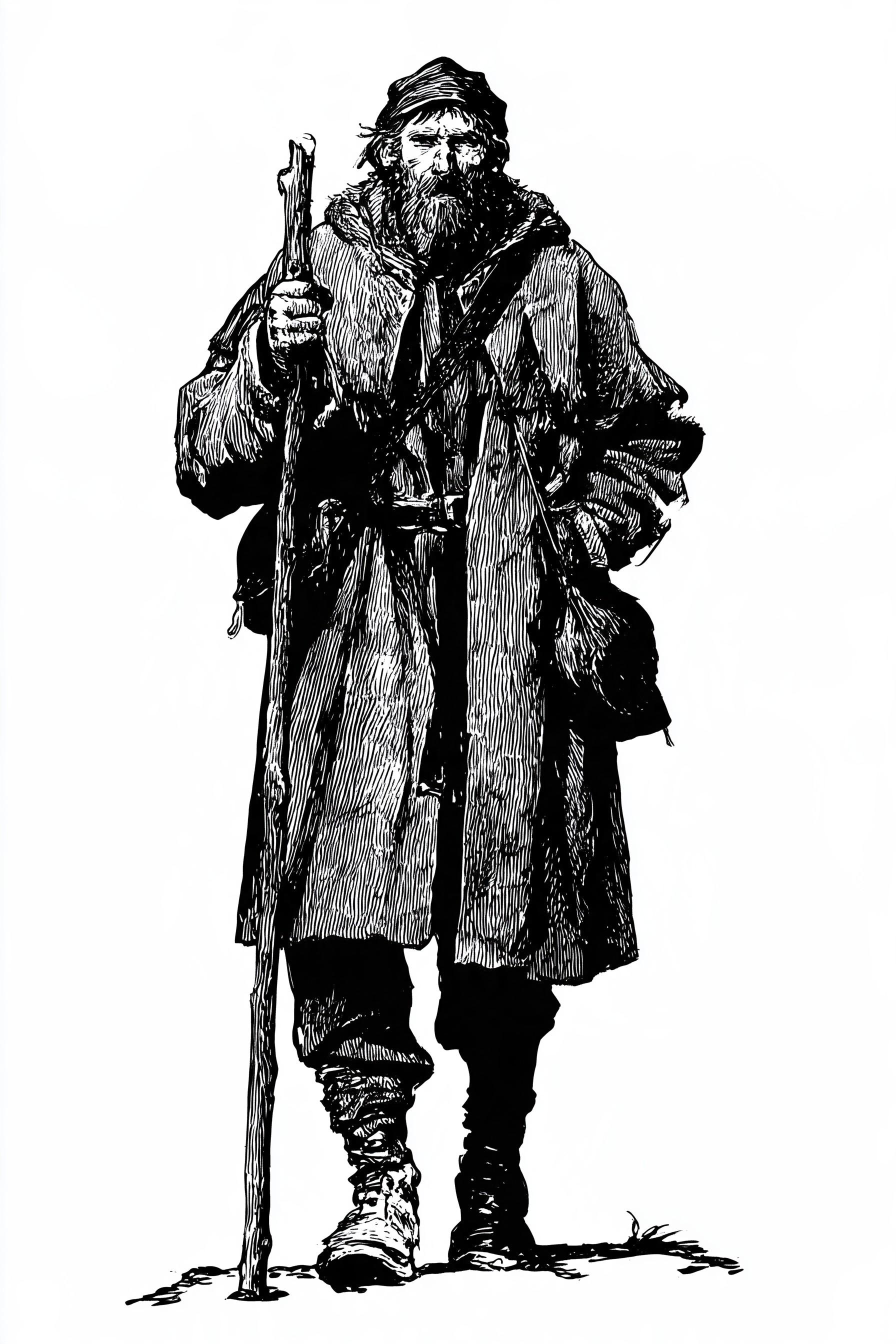
Willem speaksOn the two soldiers and the book
As the old woman told it
I liked the old woman's soldier at once. He takes the terms. A soldier takes terms. I set that line and nodded at the case as though it could see me.
Fifteen years without shaving, without cutting his hair, without blowing his nose or changing his clothes. I counted the years on the copy as I set them, the way you count the lines on a page to see whether it will fill. Fourteen years of gold and alms and a face like a wilderness. Then the treasury runs dry, and the king needs him, and the daughters look at the portrait.
I have been looked at like that. Not by princesses. By the carrier, the first time he climbed the stair and found me at the bench and understood what I was. He did not refuse me. He put the bundle down and went away quickly, and came back the next week, and the week after. That is a kind of youngest daughter. Evidently this must be my lot. I will see what God shall give.
The elder devil asks the little one to account for himself, and the little one has kept good books. He lost one soul and gained two. The elder finds it well reckoned. I set that slowly. I have kept accounts. I know what it is to look at a column and find that it comes out, and to wish it did not.
In that telling, the term ended. That is the old woman's last word, and she says it like a woman who has told the tale many times and knows where it stops.
As the fiddler told it
The fiddler's soldier is younger, and he does not take terms. He makes a trade, which is not the same thing. A fiddle for a book. Three days.
The three days were three years.
I stopped there and put the stick down. I know that line. I came to this bench for one night's work, I think, and the night has been three hundred and forty years. I did not notice it going either.
He comes up the lane, and he knows the bend and the house and the door. His mother sees him and runs. He stands in the road and looks back along it, as if the mistake might be somewhere behind him. I have stood like that. Not in a road. At the window over the canal, looking at the water, as if the mistake might be down there still.
Then everything goes well for him for a while. The book makes him rich. He gets the fiddle back, and it will not sound, and then he loses the stranger's money at cards and the fiddle sounds again. He cures a princess. He marries her. There was a palace, and music, and a life that had not been waiting for him but was his all the same. I set that line three times, because I kept making an error in it, and I think the error was mine and not the type's. I wanted it to stop there.
It does not stop there. He wants to see the village. The stranger is waiting at the frontier.
In that telling the term never ended, because it was never a term.
I have asked Pieter, in the only way I have left to ask him, whether mine is a term. I have had no answer.
The book of what comes next
A compositor always knows what comes next. It is on the copy, on the stand beside the case. I read the next line and I set it, and I read the next, and the copy is right about everything. It has never once been wrong about what comes next.
It cannot say my name the way my mother said it.
That is the poem, and I will not set it again here. I set it once, on its own page, in a type with room around it, and then I sat with the proof for a long time. It was right about everything. It could not make her look again.
— W. van der Lee
A link to this note